
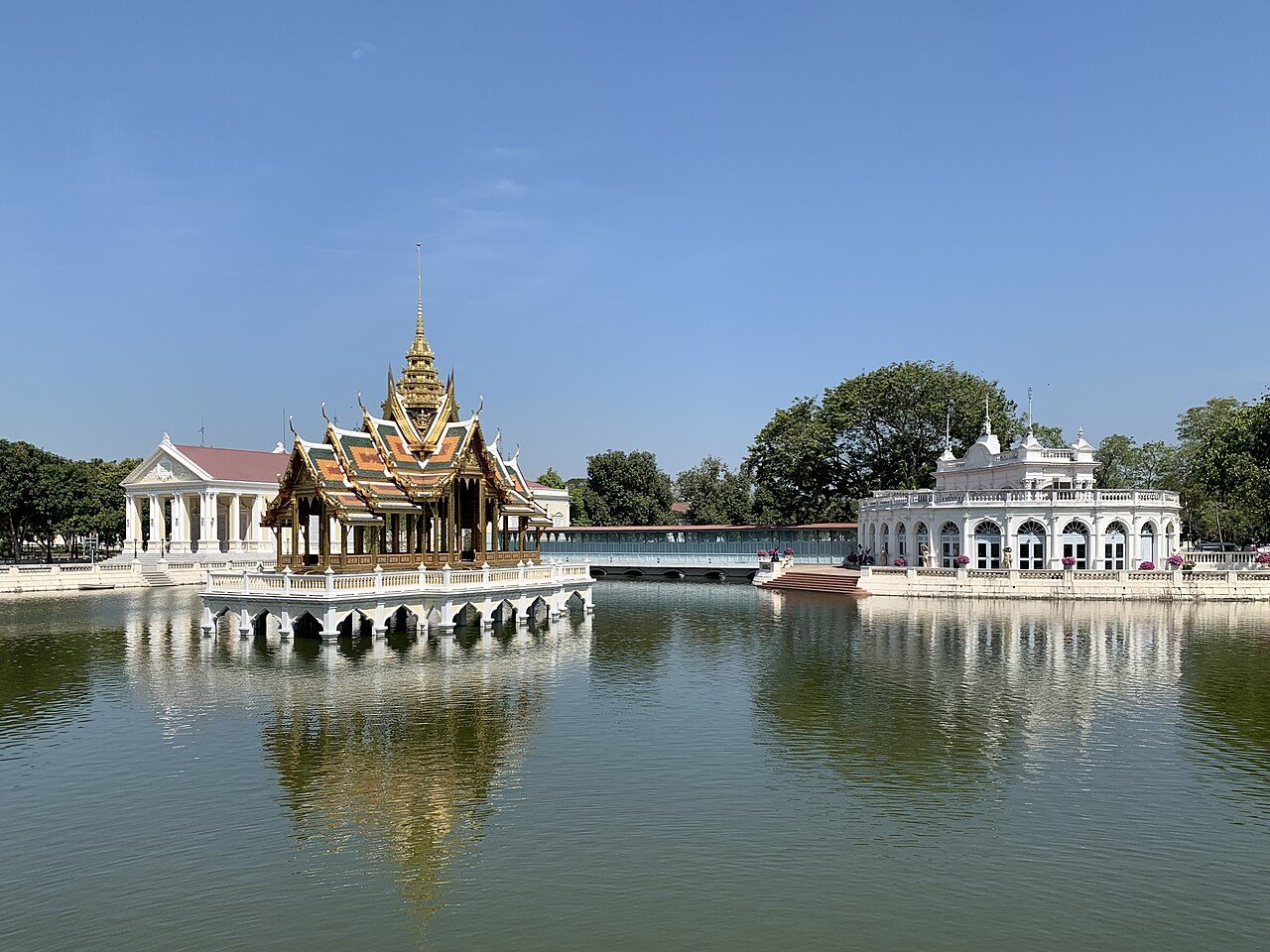
Bang Pa-In Palace
Commissioned in 1632 by King Prasat Thong and dramatically revitalized between 1872 and 1889 by King Chulalongkorn (Rama V), this royal summer retreat along the Chao Phraya River mirrors Siam’s late 19th-century cosmopolitan ambitions. The grounds unfold as an extraordinary architectural tapestry, juxtaposing European neoclassicism, Victorian Gothic arches, and traditional Siamese craft. Floating upon an ornamental lake is the complex’s centerpiece, the Aisawan Dhiphya-Asana—a golden-and-vermilion open-air Thai pavilion crowned with a soaring tiered spire—set against a backdrop of marble bridges, Swiss-chalet-style outbuildings, and manicured Renaissance-inspired topiary gardens. Walking along the sun-drenched, lotus-strewn canals, travelers cross into the Phra Thinang Wehart Chamrun, a luminous Chinese imperial residence shipped piece by piece from Canton, boasting fragrant camphor-wood corridors, intricate gold-leaf fretwork, and mother-of-pearl dragon thrones. Nearby, visitors ascend the winding spiral staircase of Ho Withun Thasana, a brightly striped, maritime-inspired observatory painted in vivid red and saffron, which frames panoramic views over the sweeping lawns and waterworks. Tucked under weeping banyan branches lies a quiet, poignant encounter: the marble cenotaph carved with Rama V’s sorrowful English poetry, dedicated to Queen Sunanda Kumariratana, whose tragic royal drowning in 1880 forever etched grief into this picturesque landscape.
More in Ayutthaya
Photo credits (4)
- Chainwit., CC BY 4.0, via Wikimedia Commons
- Vyacheslav Argenberg, CC BY 4.0, via Wikimedia Commons
- Chainwit., CC BY 4.0, via Wikimedia Commons
- Average trinmo, CC BY-SA 4.0, via Wikimedia Commons