
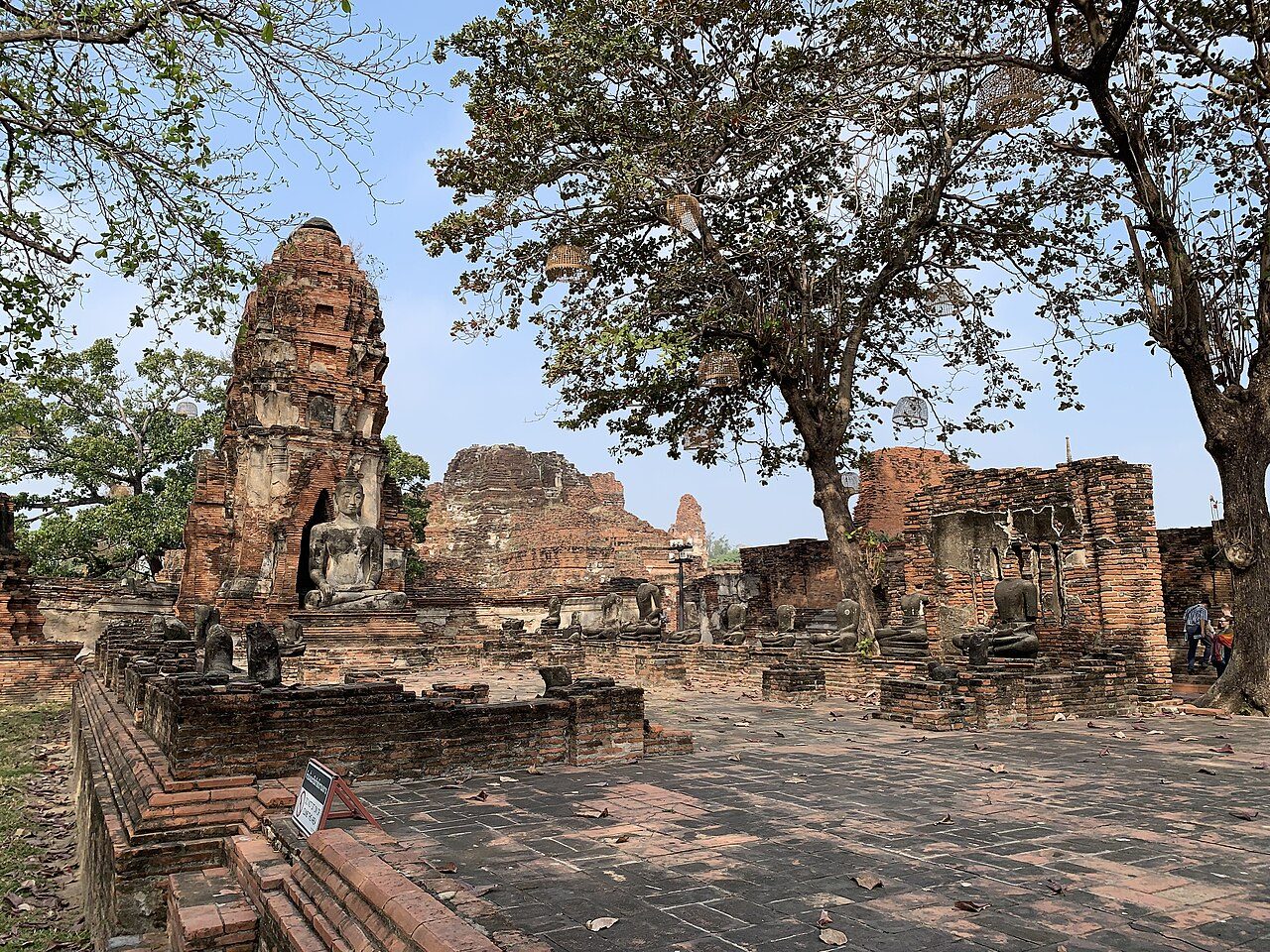
Wat Mahathat
Founded in 1374 under King Borommaracha I and expanded by King Ramesuan, Wat Mahathat served as the spiritual epicenter of the Ayutthaya Kingdom and the primary reliquary for sacred relics of the Buddha. Architecturally, the complex pioneered the early Khmer-influenced Ayutthaya style, anchored by a towering laterite and stucco *prang* (spire) that once soared nearly fifty meters before collapsing from structural decay and the devastating Burmese invasion of 1767. Today, skeletal courtyards of burnt-orange brick fan out from the shattered central tower, flanked by rows of headless stone Buddhas seated in the meditative *bhumisparsha mudra*, their severed silhouettes testifying to the brutal sacking of the imperial capital. Walking across the sun-baked clay terraces, travelers encounter a palpable, haunting stillness beneath the humid canopy. The complex's most indelible sight awaits near the entrance: a serene, fifteenth-century sandstone Buddha head cradled seamlessly within the muscular, twisting roots of a sacred banyan tree. The face rests nearly at ground level, wearing a faint, undisturbed smile amid the encroaching wood. Deep within the ruinous cloisters, the crunch of gravel underfoot and the sight of leaning octagonal chedis evoke a visceral confrontation with lost grandeur, where the scent of aged laterite and tropical rain lingers over fallen empire walls.
More in Ayutthaya
Photo credits (4)
- Chainwit., CC BY 4.0, via Wikimedia Commons
- Vyacheslav Argenberg, CC BY 4.0, via Wikimedia Commons
- Average trinmo, CC BY-SA 4.0, via Wikimedia Commons
- Chainwit., CC BY 4.0, via Wikimedia Commons