
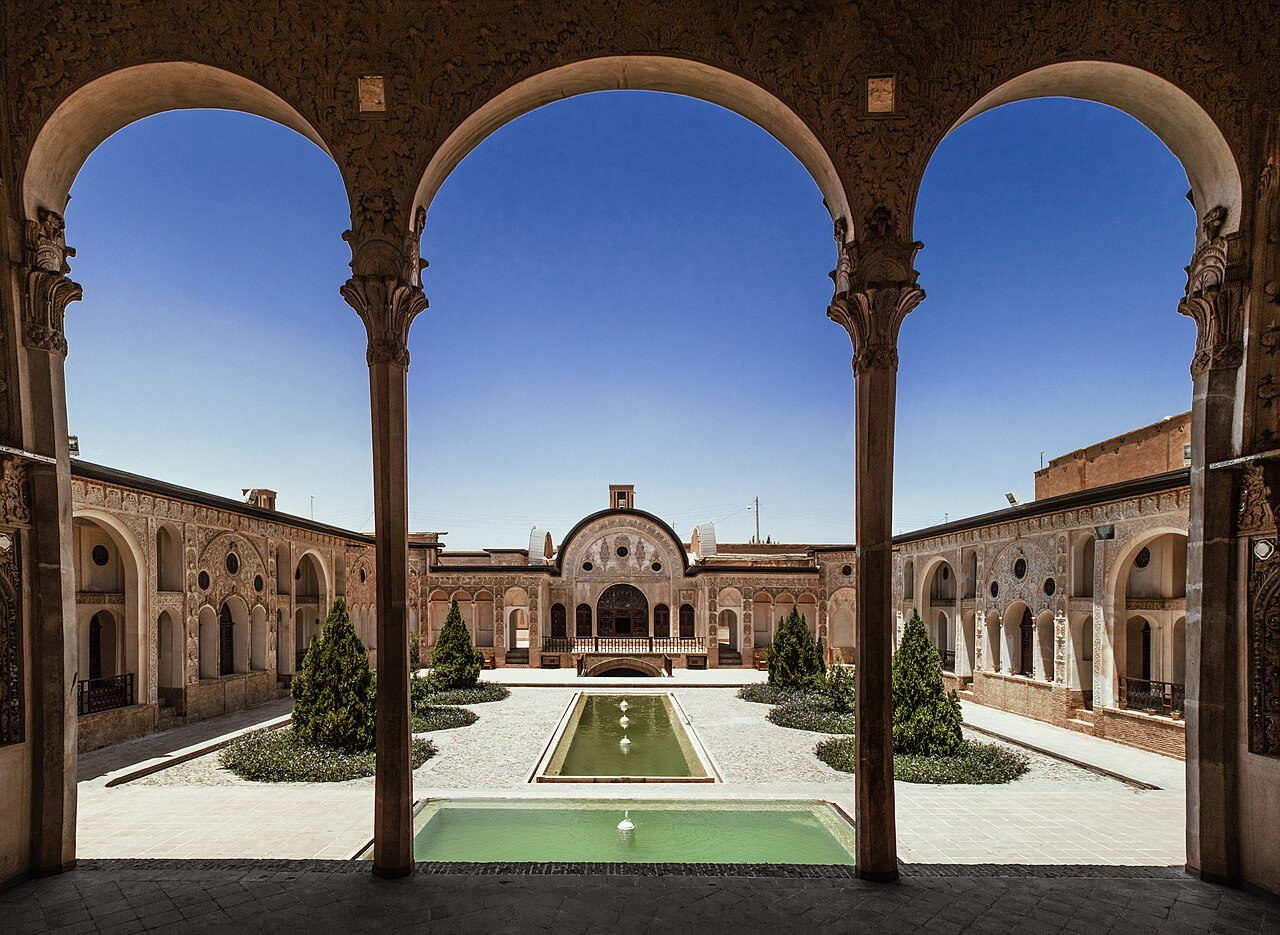
Tabatabaei House
Commissioned around 1880 by the affluent carpet merchant Seyyed Jafar Tabatabaei, this sprawling masterpiece of Qajar residential architecture was brought to life by celebrated builder Ustad Ali Maryam. To tame Kashan’s unforgiving desert climate, Maryam excavated the complex deep into the earth—employing the traditional *Goudal-baghcheh* (sunken courtyard) technique to provide natural insulation and subterranean cooling. Spanning nearly 5,000 square meters, the residence comprises forty rooms, four courtyards, and four windcatchers, meticulously divided into public reception halls (*biruni*) and secluded private family quarters (*andaruni*). Crossing the threshold, travelers descend into an oasis of stillness where dry desert heat yields to shaded subterranean corridors. Standing beside the vast central reflecting pool, visitors are enveloped by breathtaking visual complexity: the surrounding verandas boast lace-like plaster reliefs of swooping nightingales, blooming pomegranates, and mythical Homa birds sculpted into fine stucco. As the desert sun shifts overhead, light streams through floor-to-ceiling *orosi* (stained-glass) sash windows, casting brilliant geometric pools of crimson, amber, and cobalt across mirror-tiled *muqarnas* vaults, while the quiet murmur of courtyard fountains breaks the arid silence.
More in Kashan
Photo credits (3)
- Baharyahya, CC BY-SA 4.0, via Wikimedia Commons
- Unknown author, CC BY-SA 2.5, via Wikimedia Commons
- Parsa 2au, CC BY-SA 4.0, via Wikimedia Commons