

Tel Jericho
Rising from the Jordan Rift Valley more than 250 meters below sea level, Tel Jericho (Tell es-Sultan) preserves over 10,000 years of continuous human presence, anchoring its legacy as the world’s oldest fortified settlement. British archaeologist Dame Kathleen Kenyon fundamentally reshaped prehistoric archaeology here during the 1950s, slicing deep stratigraphic trenches that exposed twenty-three layered civilizations. The focal point of the lower ruins is the enigmatic Neolithic Tower, an 8.5-meter-tall conical monument of unworked fieldstones erected around 8,300 BCE. Encased within its solid stone mass lies a remarkably preserved, 22-step interior spiral staircase—the earliest known stone stairway in architectural history—fashioned by Natufian descendants for defense, communal prestige, or flood mitigation. Walking the wind-scoured earth of the mound, visitors navigate steep-walled excavation trenches that reveal raw cross-sections of antiquity: scorched destruction layers, Neolithic plastered surfaces, and the eroded revetments of Middle Bronze Age mudbrick defenses. The sensory experience is defined by the heavy, dry heat of the depression and an arresting visual juxtaposition. Standing at the tell’s apex, the desiccated, clay-hued ruins plunge straight into a vibrant oasis of emerald date palms, kept alive for millennia by the nearby freshwater spring of Ein es-Sultan, with the precipitous, honeycombed cliffs of the Mount of Temptation looming immediately to the west.
More in Jericho
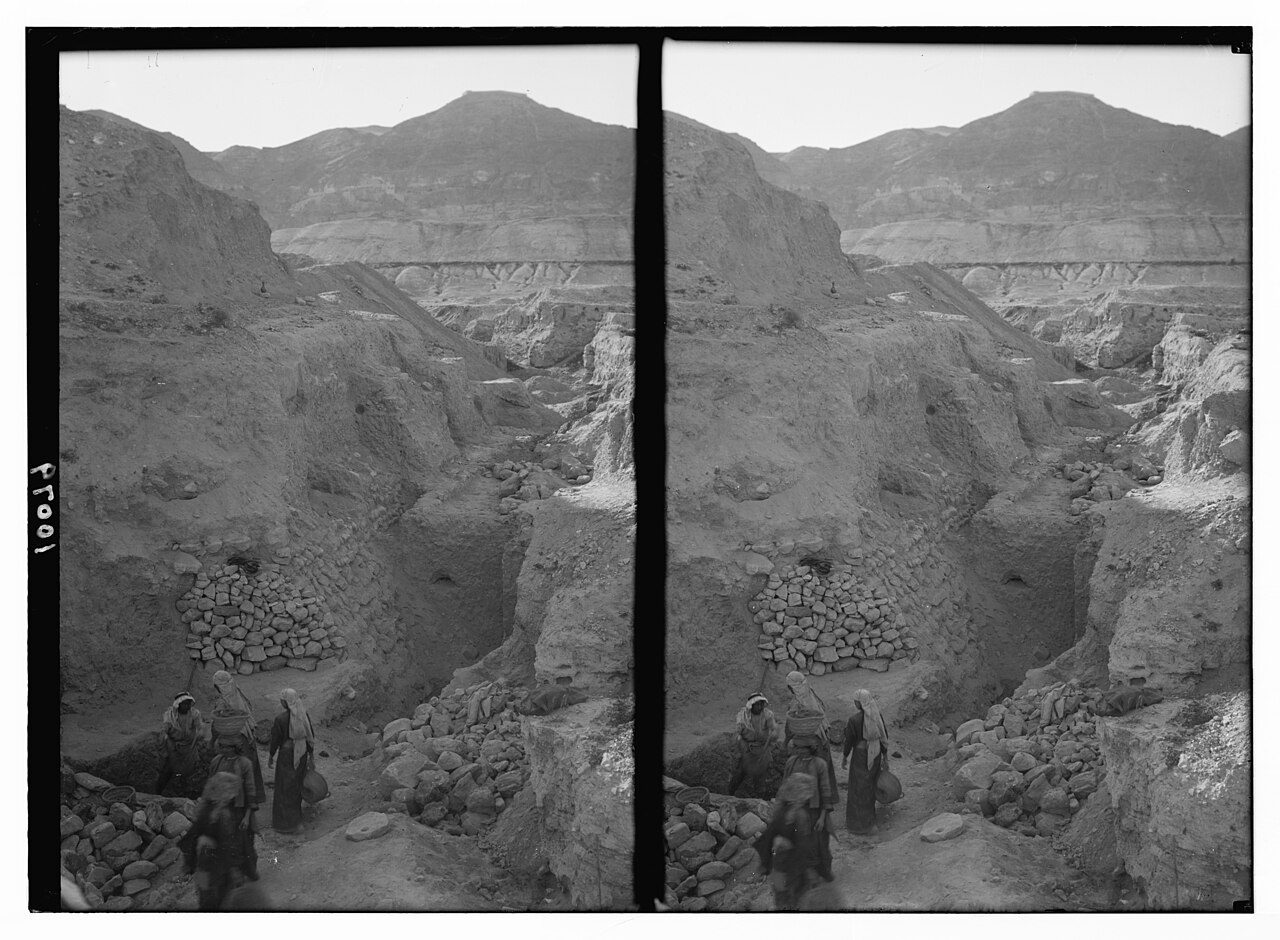
Photo credits (2)
- Arabischer Mosaizist um 735, Public domain, via Wikimedia Commons
- Matson Collection, Public domain, via Wikimedia Commons