
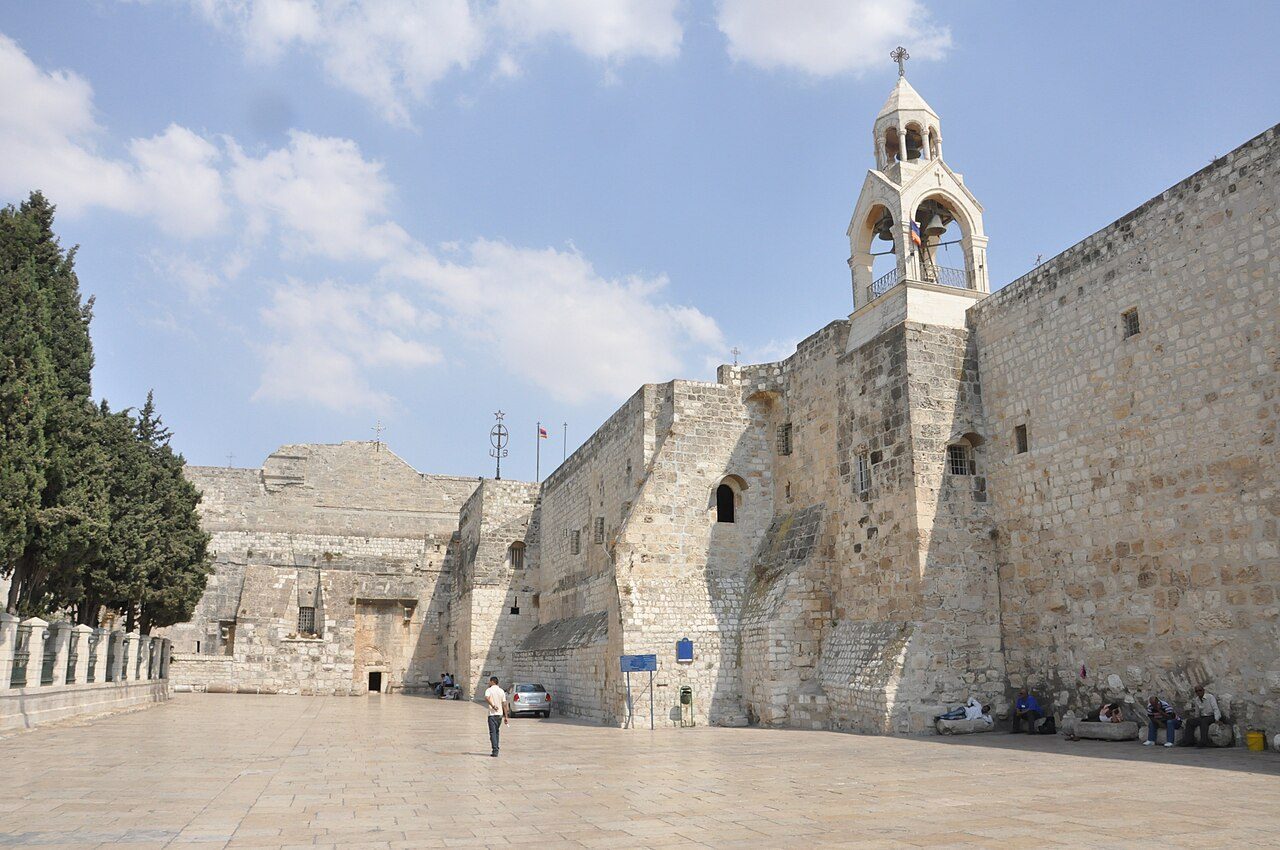
Church of the Nativity
Commissioned in 326 AD by Emperor Constantine and his mother Helena, then reconstructed by Justinian I in the sixth century, this fortress-like Byzantine basilica ranks among the oldest continuously operating Christian sanctuaries in existence. Approaching from Manger Square, you must stoop low to enter via the Door of Humility, a portal deliberately reduced in size across the Crusader and Ottoman eras to deter mounted looters. Inside, forty-four Corinthian columns of local rose-hued limestone flank the cavernous central nave. Looking down, wooden floor hatches reveal brilliant fourth-century geometric floor mosaics preserved beneath the flagstones, while high above, restored Crusader wall mosaics shimmer faintly alongside tiers of hanging silver lamps and brass censers. Descending a narrow, worn stone staircase behind the gilded Greek Orthodox iconostasis brings you into the Grotto of the Nativity, an intimate subterranean cave lined with stone masonry and centuries of soot. At its focal point, embedded into the white marble floor beneath an altar, lies a fourteen-pointed silver star bearing a Latin inscription that marks the traditional site of the birth of Jesus. Standing within this dim, subterranean chamber, you are enveloped by the sharp aroma of frankincense and melting beeswax, illuminated by fifteen flickering oil lamps that cast deep shadows across the smooth, ancient rock face.
More in Bethlehem
Photo credits (2)
- Neil Ward, CC BY 2.0, via Wikimedia Commons
- Alexey Goral, CC BY-SA 4.0, via Wikimedia Commons