
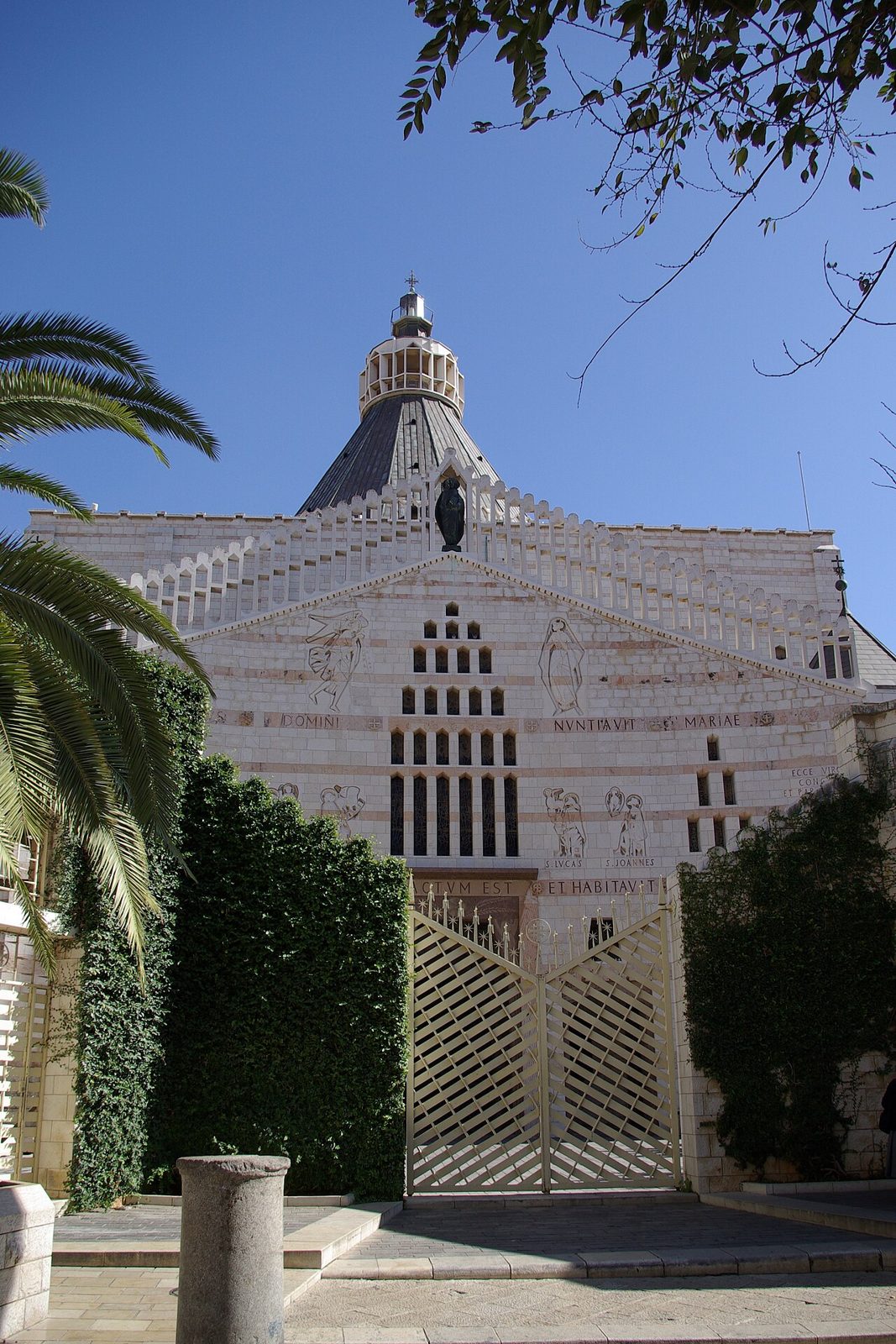
Basilica of the Annunciation
Rising over the limestone rooftops of lower Galilee, the Basilica of the Annunciation—completed in 1969 by Italian architect Giovanni Muzio—anchors the subterranean bedrock venerated as Mary’s childhood home. Constructed in a bold, sculptural Brutalist style layered atop fifth-century Byzantine and twelfth-century Crusader foundations, the two-tiered sanctuary is crowned by a dramatic 55-meter-high concrete cupola. Modeled on an inverted Madonna lily opening its petals toward the heavens, this towering lantern funnels geometric shafts of daylight into the upper nave. Along the courtyard portico and interior walls, a striking global gallery unfolds: dozens of bespoke Marian mosaics gifted by nations worldwide, depicting the Virgin in everything from Japanese silk and pearl-embroidered kimonos to vibrant Mexican rebozos. Descending into the lower level, modern concrete yields to the hushed, twilight stillness of the sunken crypt, where the air cools and carries the faint scent of beeswax and damp limestone. At its heart lies the Grotto of the Annunciation, a rock-cut cavern framed by Crusader masonry and an eighteenth-century Franciscan altar bearing the inscription *Verbum Caro Hic Factum Est* ("Here the Word was made Flesh"). Standing at the wrought-iron balustrade, travelers peer into the ancient domestic cave, feeling the quiet weight of antiquity where early Byzantine devotional graffiti still etches the stone, bridging archaeological reality with biblical tradition.