
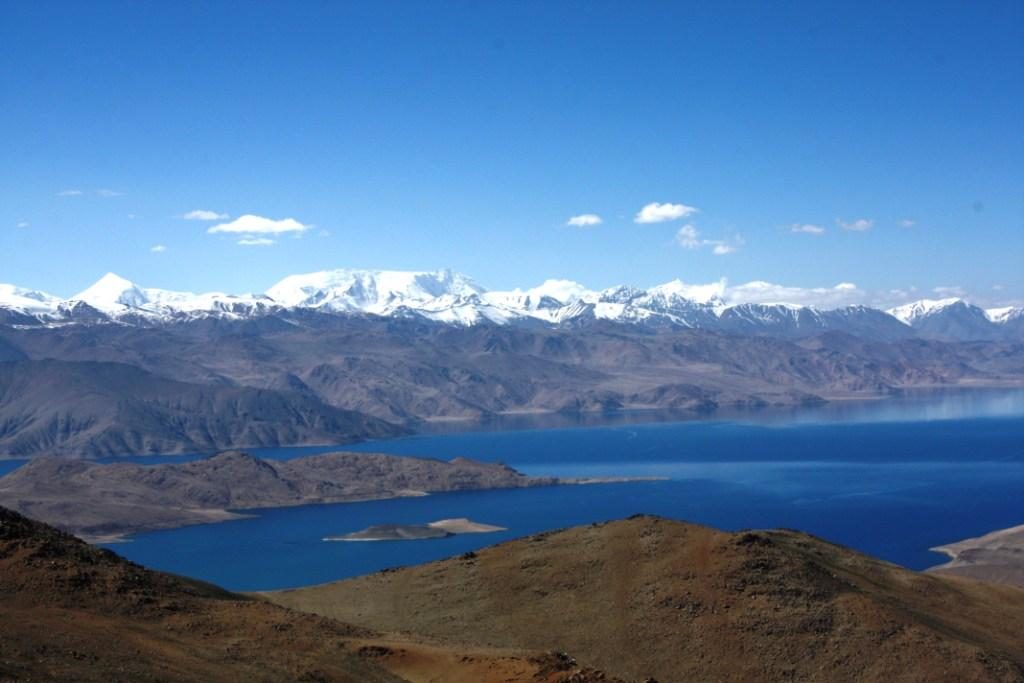
Karakul Lake
Formed by a cataclysmic meteorite strike millions of years ago, this endorheic basin rests at a breathless 3,914 meters above sea level in the eastern Pamir Mountains. Mapped during the 19th-century Great Game and studied by Swedish explorer Sven Hedin in 1894, the lake—whose Turkic name translates to "Black Lake"—anchors an austere landscape long traversed by semi-nomadic Kyrgyz pastoralists. A rugged peninsula juts from the northern shore, nearly severing the water into two hydrographic realms: a shallow eastern shelf barely 22 meters deep and a shadowed western abyss plunging down 236 meters, completely hemmed in by the jagged, glaciated perimeter of the Trans-Alay Range. Standing along the exposed shoreline, visitors confront a blinding ring of white salt crust contrasting against water that shifts violently from luminous aquamarine to deep cobalt as mountain squalls roll off the peaks. The sub-zero, oxygen-deprived wind carries an eerie, ringing silence, broken only by the crunch of saline gravel underfoot or the cries of migratory bar-headed geese nesting on isolated islets. In the adjacent, windswept settlement of Karakul, flat-roofed adobe homes provide spartan respite, where travelers warm themselves over yak-dung stoves while gazing across the water toward the colossal 7,134-meter silhouette of nearby Peak Lenin.