
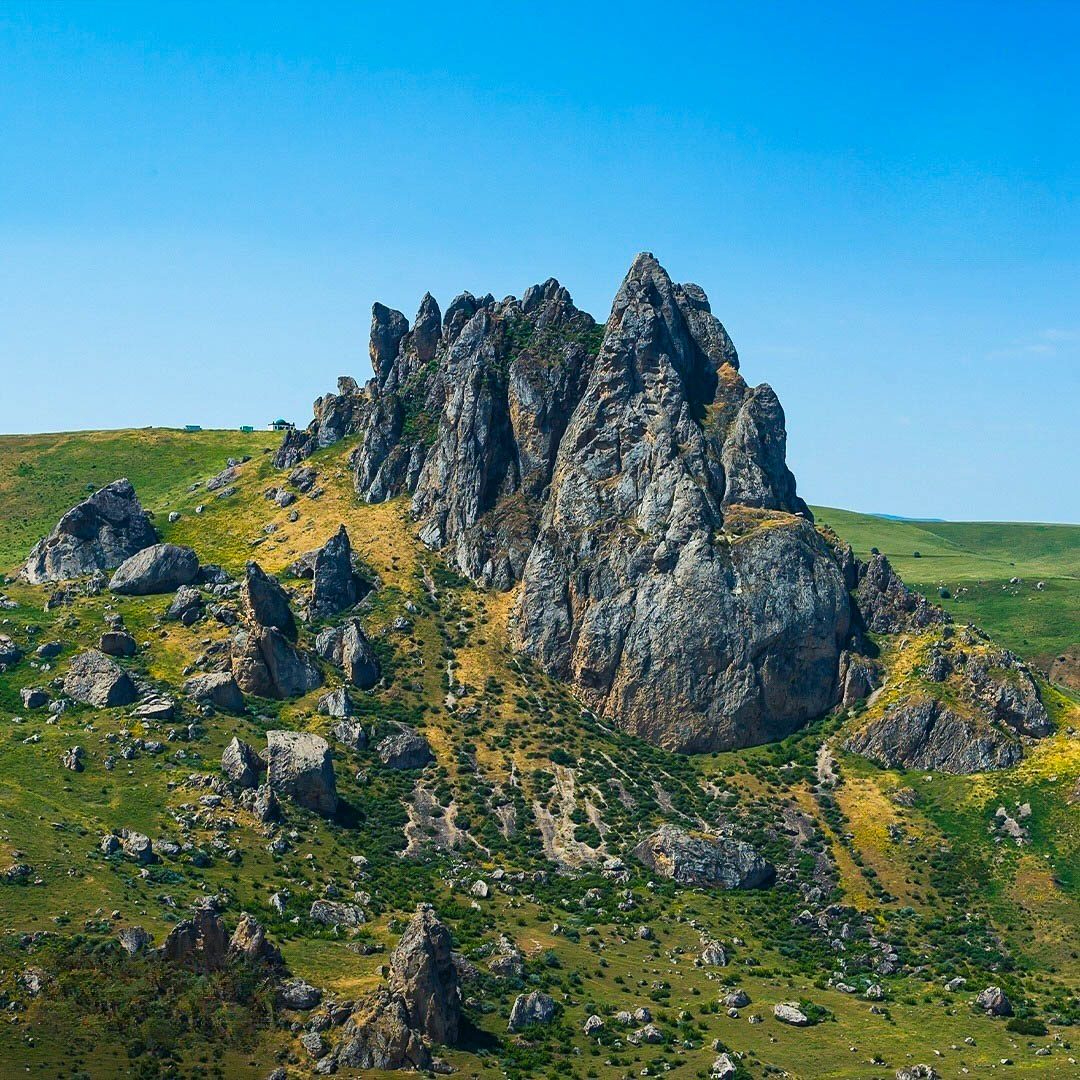
Besh Barmag Mountain
Rising abruptly from the arid coastal plain along the historic route to Quba, Besh Barmag—meaning "Five Finger Mountain"—juts 445 meters above the Caspian shore like a petrified, gargantuan hand. Revered for millennia, this jagged dolomitic limestone crag served ancient mariners as a navigational beacon and Silk Road caravans as a holy sanctuary. Local lore binds the mountain to the immortal prophet Khidr (Khezr), who supposedly discovered the water of life at a hidden spring nestled within its clefts. Scattered across its slopes lie the eroded masonry ruins of a 6th-century fortress, erected by Sasanian engineers to reinforce Caucasian defense lines and control the narrow migratory corridor between the sea and the Greater Caucasus foothills. Ascending to the summit demands negotiating a windswept path followed by steep, rusted iron stairways bolted directly into sheer rock faces. At the top, relentless Caspian gales howl through the narrow fissures between the five stone "fingers." Visitors find themselves enveloped in the sharp, herbal fragrance of burning *üzerlik* (wild rue), an incense lit by local pilgrims who arrive to pray at the compact stone shrine and tie fabric scraps to desert shrubs for blessings. Standing on the narrow, vertiginous ledge between the weathered rock spires, travelers look down upon a surreal double panorama: the endless cerulean expanse of the Caspian Sea to the east, and the golden, undulating ridges of the Azerbaijani semi-desert rolling west.
More in Quba

Photo credits (3)
- Sefer azeri, CC0, via Wikimedia Commons
- Irada, CC BY-SA 3.0, via Wikimedia Commons
- David Uriarte, CC BY-SA 4.0, via Wikimedia Commons