
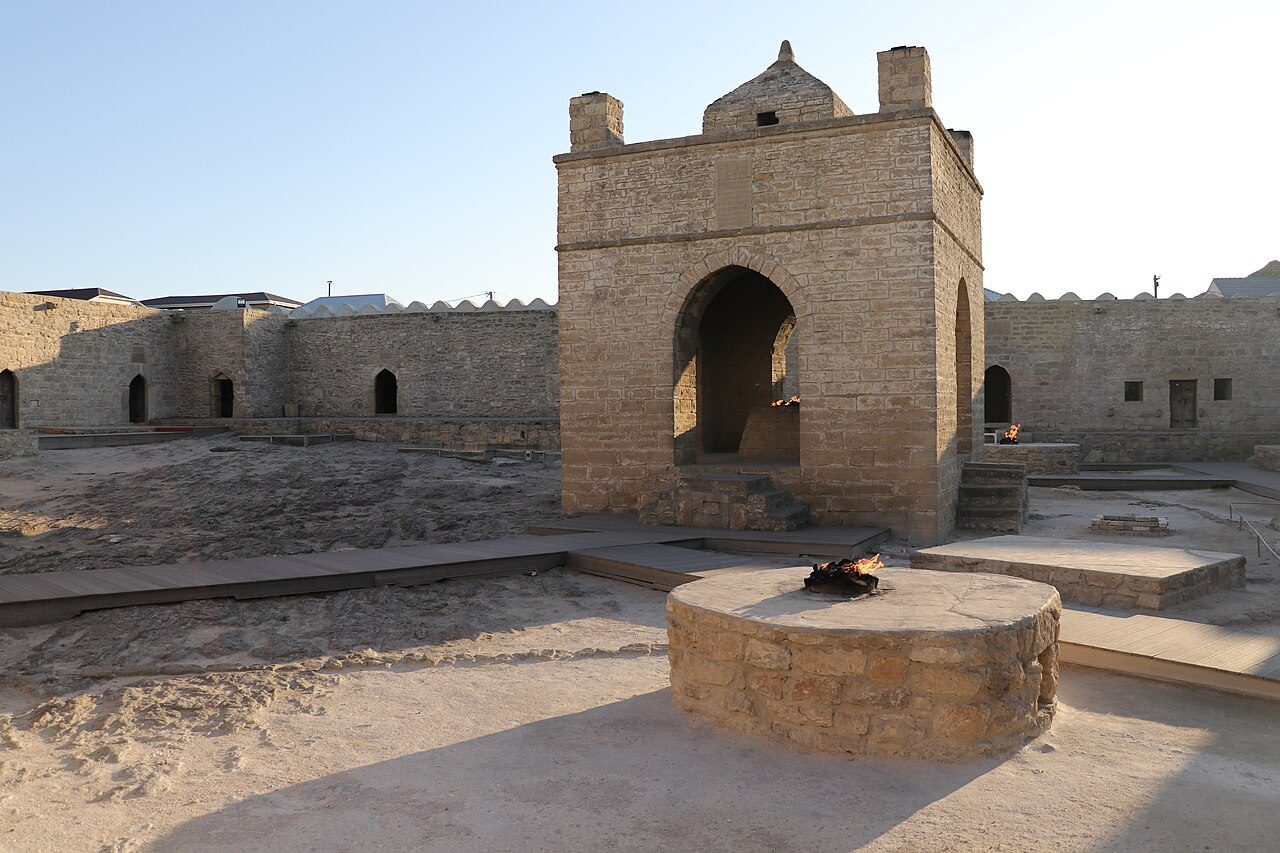
Ateshgah Fire Temple
Rising from the windswept plains of Surakhani on the Absheron Peninsula, the Ateshgah Fire Temple stands as a fortress-like sanctuary constructed primarily during the 17th and 18th centuries by Multani Hindu and Sikh merchants traveling the northern Silk Road. Enclosed by crenellated limestone walls, the pentagonal complex mirrors a fortified caravanserai designed to shelter ascetic pilgrims and trade caravans alike. At its geometric center rises an open-sided, four-pillared stone pavilion—a traditional *chahar taq* crowned by a modest cupola—where a dedicated flame flickers over an altar historically fed by natural underground gas vents. Surrounding the perimeter, twenty-four austere monastic cells display carved lintels inscribed in Sanskrit, Gurmukhi, and Persian, bearing invocations to deities such as Agni, Shiva, and Ganesha. Stepping through the arched entrance into the flagstone courtyard, visitors are immediately greeted by the quiet expanse and the hypnotic glow of the central hearth. A dry Caspian breeze sweeps across the enclosure, carrying the faint warmth of the rekindled fire against the ancient masonry. Peeking into the whitewashed cells reveals low ceilings, soot-blackened prayer niches, and reconstructed scenes depicting the extreme ascetic penances once practiced by sadhus here. The stark, earthen-hued architecture contrasts vividly with Baku's azure skies, immersing travelers in an unexpected confluence of Indian devotional traditions, Persian fire worship, and the volatile geology of the Land of Fire.
More in Baku


Photo credits (5)
- Jesper Ahlin Marceta, CC BY-SA 4.0, via Wikimedia Commons
- Press Service of the President of the Republic of Azerbaijan, CC BY 4.0, via Wikimedia Commons
- Avisadehh, CC0, via Wikimedia Commons
- Frokor, CC BY-SA 3.0, via Wikimedia Commons
- Azərbaycan Respublikası Ekologiya və Təbii Sərvətlər Nazirliyi, Public domain, via Wikimedia Commons