
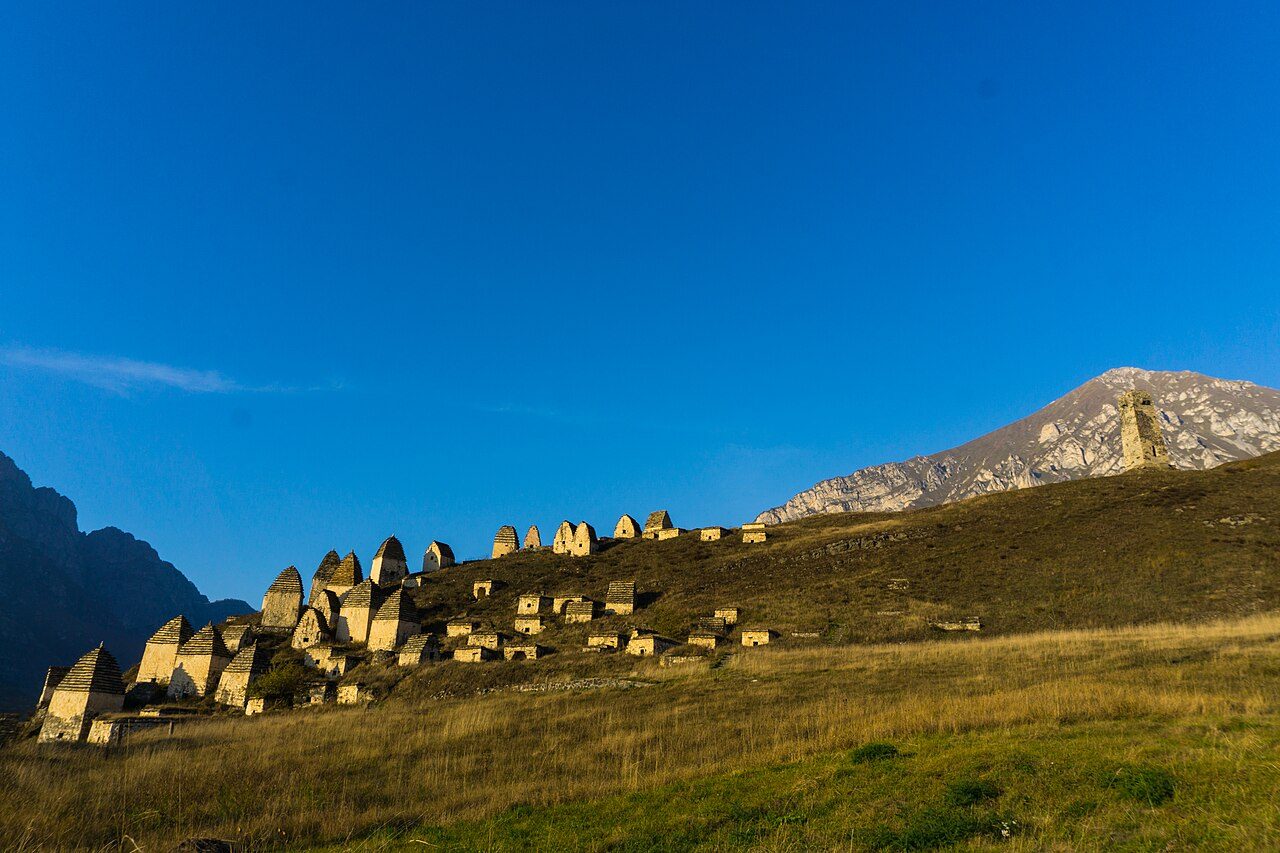
Dargavs City of the Dead
Clinging to a windswept ridge in North Ossetia's Gizeldon River valley, southwest of Vladikavkaz, stands the medieval necropolis of Dargavs. Built between the 14th and 18th centuries by the Alans—ancestors of the modern Ossetians—this mortuary complex comprises 99 whitewashed stone crypts, known locally as *zappadzkhaty*. The structures exhibit vernacular dry-stone masonry, featuring square foundations capped by distinctive stepped pyramidal roofs tiled with dark shale slates that channel rainwater away from the mortar. Historically, these vaults served as collective family sepulchers and, during devastating 18th-century plague outbreaks, as self-imposed quarantine houses where infected villagers retreated to await death, preserving their neighboring clans. Today, walking among the staggered tombs against the jagged, snow-capped backdrop of the Greater Caucasus, travelers confront a stark encounter with the deep past. Peering through the small square openings set low into the masonry reveals a preserved underworld: skeletal remains, woven textiles, and ancient bodies resting inside boat-shaped wooden coffins—relics of a pre-Christian belief that the dead had to cross a subterranean river to reach the afterlife. Tarnished copper coins, cast inside by mourners over centuries as toll money, still glitter in the crypt floor dust. The silence across the slope is broken only by mountain drafts whistling through the eaves, creating an atmosphere that is simultaneously pastoral and deeply solemn.
More in Vladikavkaz
Photo credits (2)
- Trip.with.taste, CC BY-SA 4.0, via Wikimedia Commons
- Alexander Novikov, CC BY-SA 4.0, via Wikimedia Commons