 New added
Hallgrimskirkja
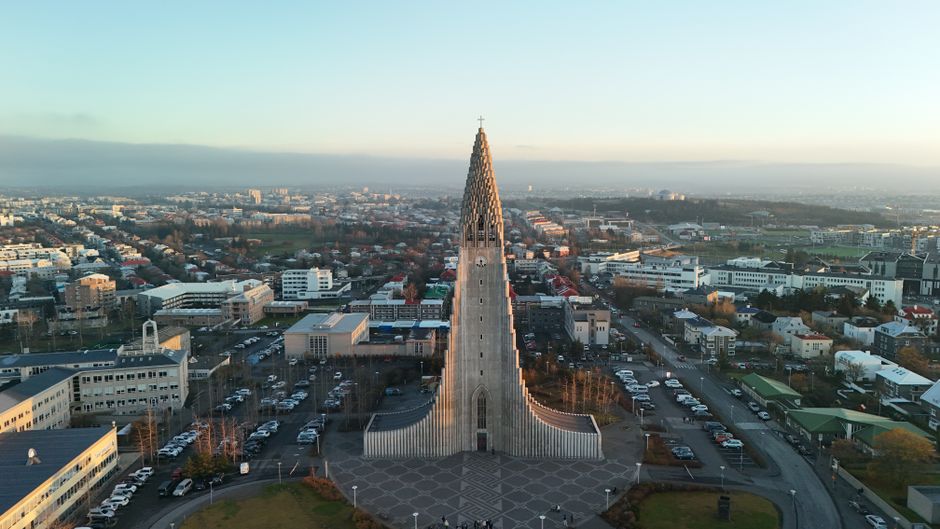
Rising like an erupting geyser of pale stone over Skólavörðuholt hill, Hallgrímskirkja anchors the Reykjavík skyline with monumental Icelandic Expressionism. Commissioned in 1937 and designed by State Architect Guðjón Samúelsson, the Lutheran parish church took over four decades to construct before its 1986 consecration, honoring 17th-century hymn writer Hallgrímur Pétursson. Samúelsson modeled the soaring, 74.5-meter stepped façade after the hexagonal basalt columns carved by cooling lava flows at Svartifoss waterfall. Guarding the plaza outside, Alexander Stirling Calder’s bronze statue of Norse explorer Leif Erikson—gifted by the United States in 1930 to commemorate the millennium of Iceland’s Alþingi parliament—stands resolute against the whipping subpolar winds. Inside, the sensory atmosphere shifts from the brisk North Atlantic chill to austere, light-flooded quietude. Beneath towering rib-vaulted ceilings, the minimalist whitewashed nave draws the gaze toward its centerpiece: a gargantuan, 15-meter-tall mechanical organ crafted by German builder Johannes Klais, boasting 5,275 pipes that send deep, seismic vibrations through the concrete ribs during recitals. Visitors queue for the lift ascending to the open-air clock tower, stepping out into whistling gusts to take in Iceland's defining urban panorama. From this vantage point, Reykjavík unfolds below in crisp geometric patterns—a vivid quilt of red, turquoise, and yellow corrugated-iron rooftops set against the ink-blue waters of Faxaflói Bay and the snow-dusted spine of Mount Esja.