 New added
Royal Ontario Museum
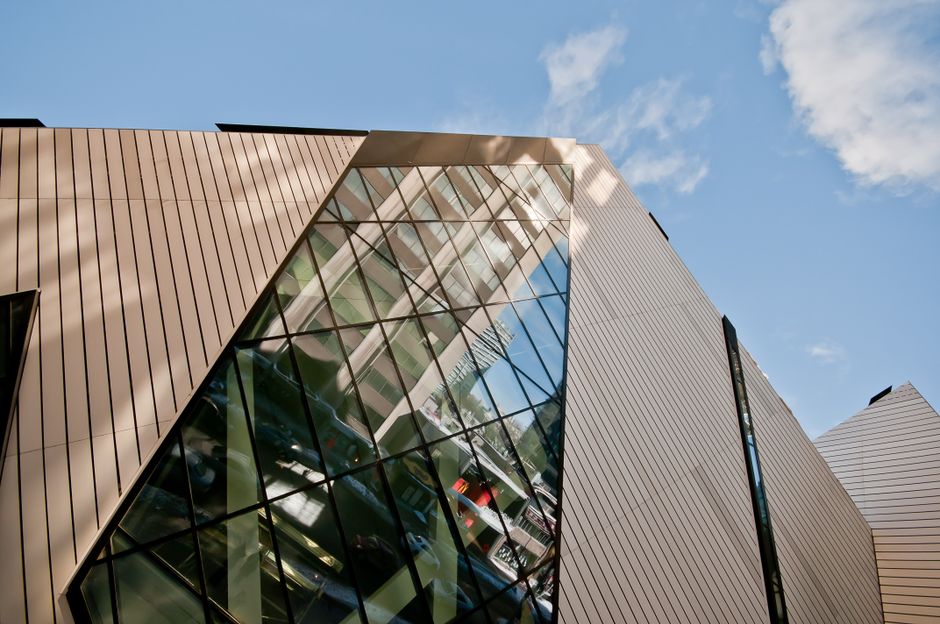
Opened in March 1914 by Prince Arthur, Duke of Connaught, the Royal Ontario Museum presents a dramatic architectural collision between Edwardian heritage and radical deconstructivism. Architects Frank Darling and John A. Pearson originally cloaked the institution in Queenston limestone and buff brick, crafting an Italianate Neo-Romanesque facade of rounded arches and carved relief friezes. In 2007, architect Daniel Libeskind shattered this classical symmetry by grafting the Michael Lee-Chin Crystal directly into the historic masonry. Five intersecting, crystalline prisms clad in brushed German aluminum and steel-ribbed glass jut out over Bloor Street at sharp angles, creating a jarring, brilliant dialogue across centuries. Crossing the threshold, travelers pass beneath the 1933 Rotunda’s soaring dome, where thousands of Venetian glass tiles glitter in gold-leaf mosaics depicting global civilizations. The floor then gives way to Libeskind’s atrium, where slanted, white-plaster walls tilt overhead, funneling natural light through asymmetrical slit windows. In the dinosaur galleries, visitors crane their necks beneath “Gordo,” an authentic ninety-foot *Barosaurus* skeleton anchoring the sunlit hall, before retreating into the hushed quiet of the Bishop White Gallery to stand before towering 14th-century Yuan dynasty temple frescoes. Standing at the raw seam between heritage brick and canted modern steel, one feels entirely suspended between deep antiquity and the avant-garde.