
Achilleion
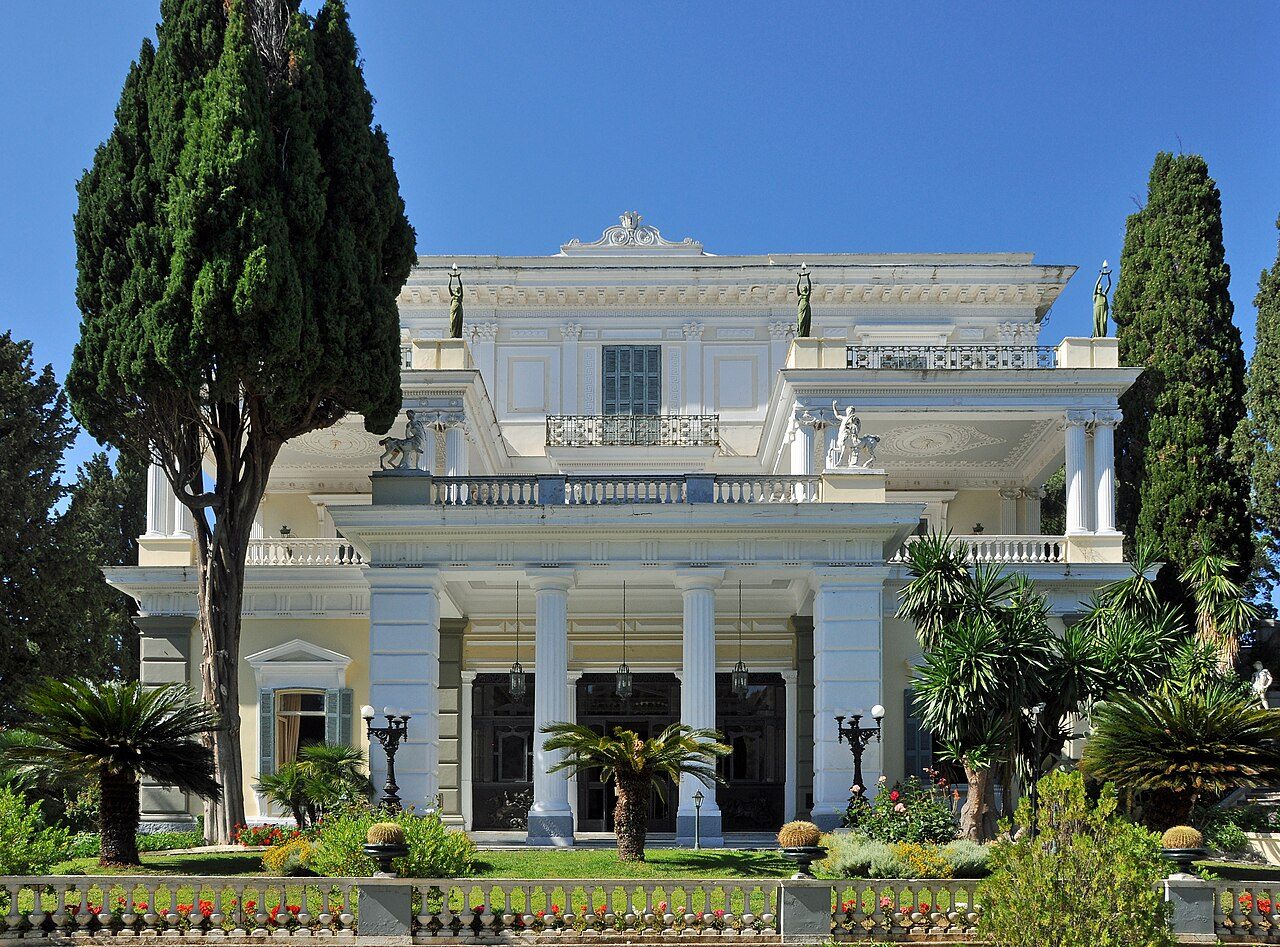
Commissioned in 1889 by Empress Elisabeth of Austria—the sorrow-stricken “Sisi”—following the tragic suicide of her son Crown Prince Rudolf, the Achilleion stands above the village of Gastouri as a palatial sanctuary of escapism. Designed by Italian architect Raffaele Caritto in a blend of Neoclassical and Pompeian styles, the palace reflects Elisabeth’s obsession with Homeric heroism. Inside, beneath soaring ceilings, visitors encounter the grand staircase leading to Franz Matsch’s monumental 1892 fresco, which portrays Achilles dragging Hector’s body past the walls of Troy from a charging chariot. After Elisabeth’s assassination, Kaiser Wilhelm II purchased the estate in 1907, introducing military austerity to the palace's intricate salons and marble colonnades. Outside, the estate unfolds into multi-tiered botanical gardens perfumed by jasmine, bougainvillea, and century-old cypresses that frame breathtaking vistas across the azure Ionian Sea toward Corfu Town. Visitors trace quiet paths along the Peristyle of the Muses, an open colonnade lined with statues of the nine muses and classical philosophers, before reaching the emotional heart of the grounds: Ernst Herter’s white-marble sculpture, *Dying Achilles*. Capturing the hero clutching the fatal arrow in his heel, the sculpture radiates the poignant vulnerability Sisi reposed in. In sharp contrast stands the colossal, shield-bearing bronze *Triumphant Achilles*, erected by Kaiser Wilhelm to command the lower terrace—leaving travelers suspended between the distinct artistic obsessions of two fallen European dynasties.
More in Corfu
Photo credits (2)
- Marc Ryckaert ( MJJR ), CC BY 3.0, via Wikimedia Commons
- Matthaus Merian, Public domain, via Wikimedia Commons