
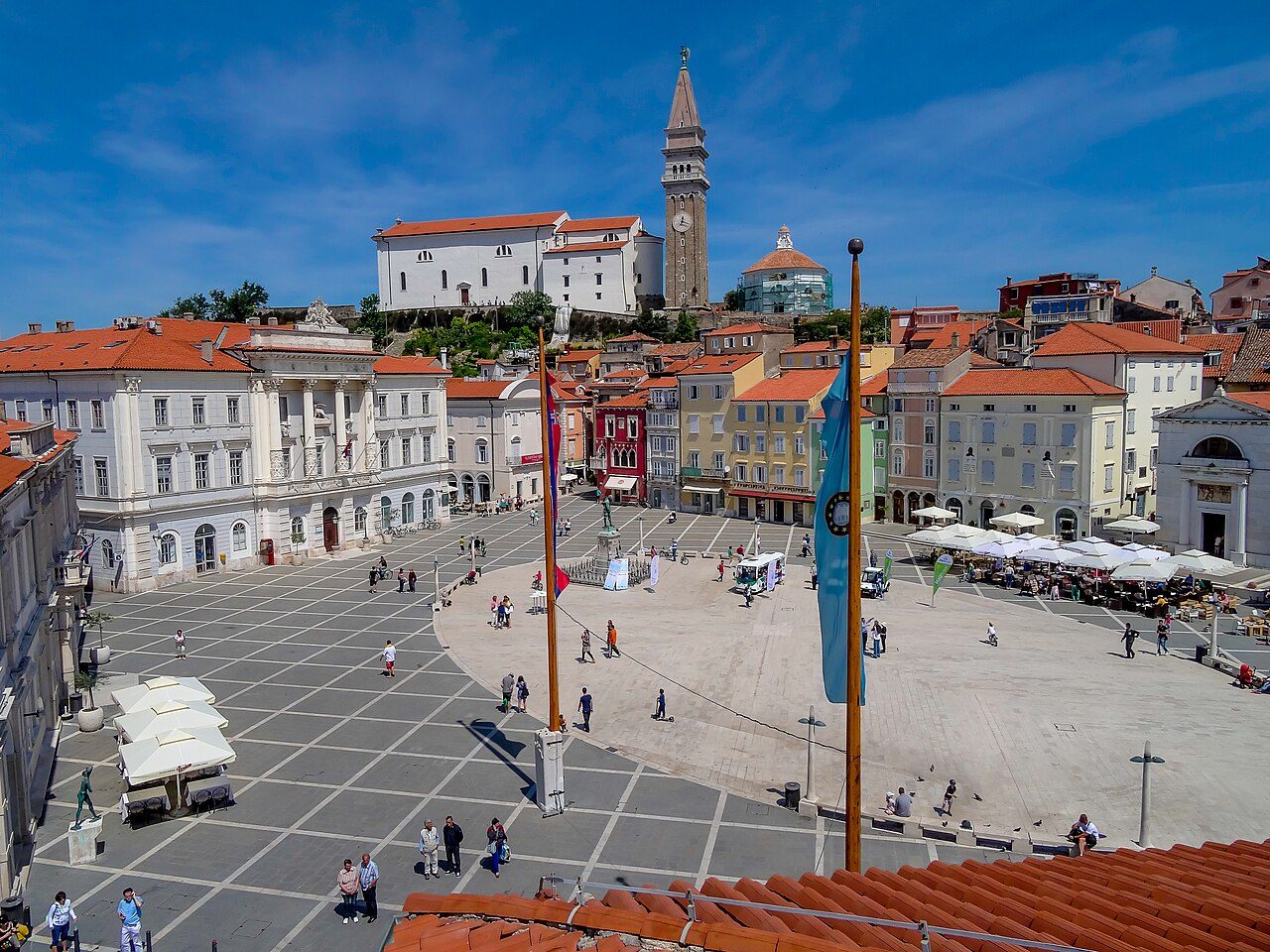
Tartini Square
Paved in pale Istrian marble, the wide elliptical expanse of Tartini Square was once a sheltered fishing dock until municipal authorities filled the silted basin in 1894 to create an open civic arena. At its focal point stands the dynamic bronze monument of Piran-born violinist and composer Giuseppe Tartini, cast by sculptor Antonio Dal Zòtto in 1896 to commemorate the artist's bicentenary. Encircling this seaside stage is an architectural tapestry rooted in Venetian heritage, dominated by the 15th-century Venetian House (Benečanka). This striking crimson jewel of Venetian Gothic design features pointed trefoil windows, an intricate stone corner balcony, and an ironic relief plaque reading *Lasa pur dir* ("Let them talk"), carved to silence the town’s historical gossips. Standing on the smooth, polished flagstones, travelers encounter a bright, sun-bleached amphitheater where the briny Adriatic air mingles with the ambient clatter of porcelain from café terraces along the 19th-century Neoclassical Town Hall. Glancing upward, visitors take in the commanding gaze of the hilltop Parish Church of Saint George, whose 1608 bell tower—an intentional replica of Venice’s San Marco campanile—casts long afternoon shadows across the plaza. Children trace circles along the marble perimeter while Tartini, bow in hand, presides perpetually over the daily rhythms of coastal Istria.