
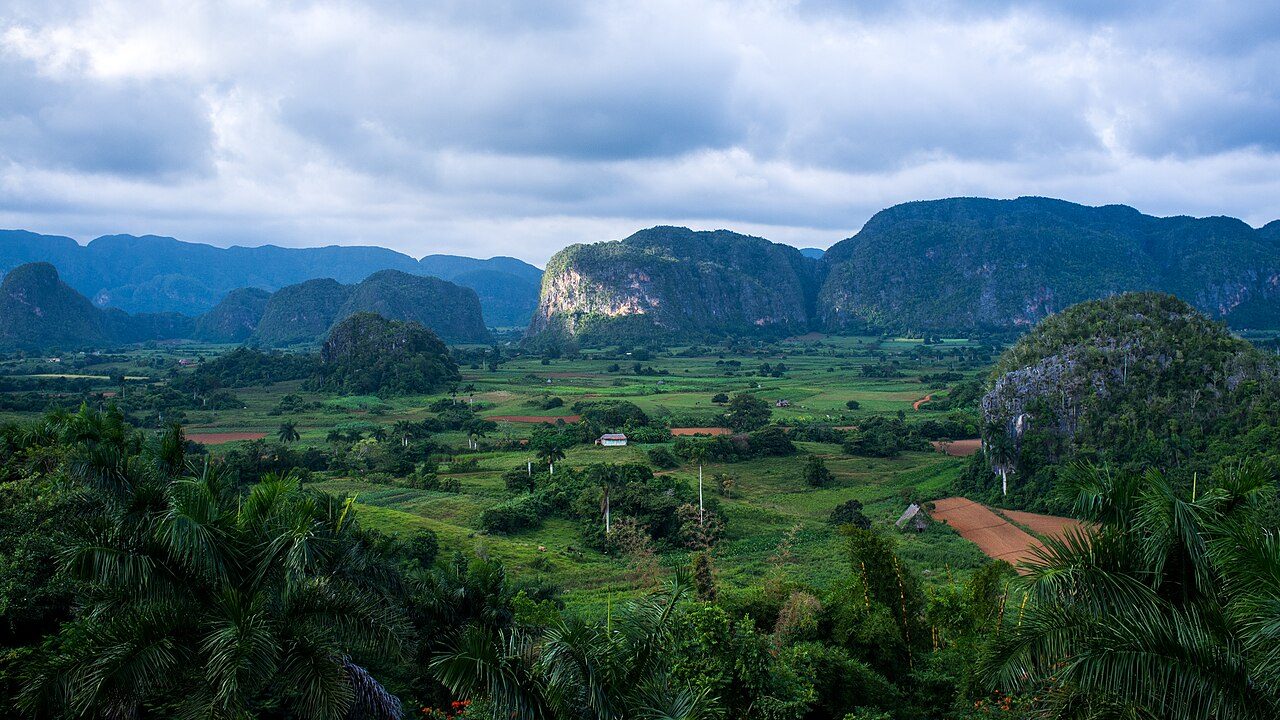
Vinales Valley
Rising abruptly from the floor of the Sierra de los Órganos, the bulbous limestone karst hills known as *mogotes* anchor the dramatic topography of Viñales. Preserving an agrarian rhythm unchanged since the 19th-century tobacco boom, this UNESCO World Heritage cultural landscape functions largely through animal traction rather than modern machinery. Across iron-rich, crimson fields, oxen drag wooden plows guided by straw-hatted *vegueros* cultivating the raw components of authentic Cuban cigars. Wooden curing barns (*casas de tabaco*) dot the emerald carpet, their steep gables thatched with royal palm fronds to naturally regulate humidity. Dominating the cliff face of the Pita mogote stands the 120-meter-long *Mural de la Prehistoria*, painted in 1961 by Leovigildo González Morillo to illustrate evolutionary history in sweeping bands of yellow, red, and blue pigment. At dawn, travelers witness thick ribbons of fog unfurling between sheer cliff walls, burning off to expose wild orchids and prehistoric cork palms clinging to the rock. The tactile reality of the valley hits immediately: the leathery, sweet aroma of curing tobacco leaves suspended in dim barns, the crunch of dry red clay underfoot, and the damp chill within the cavernous Cueva del Indio, an ancestral indigenous shelter carved by an underground river. Traversing the dirt trails on horseback, visitors encounter a sensory tableau of creaking wooden stirrups, the call of the endemic Cuban trogon, and farmers hand-rolling freshly dried *secador* leaves with effortless precision.