
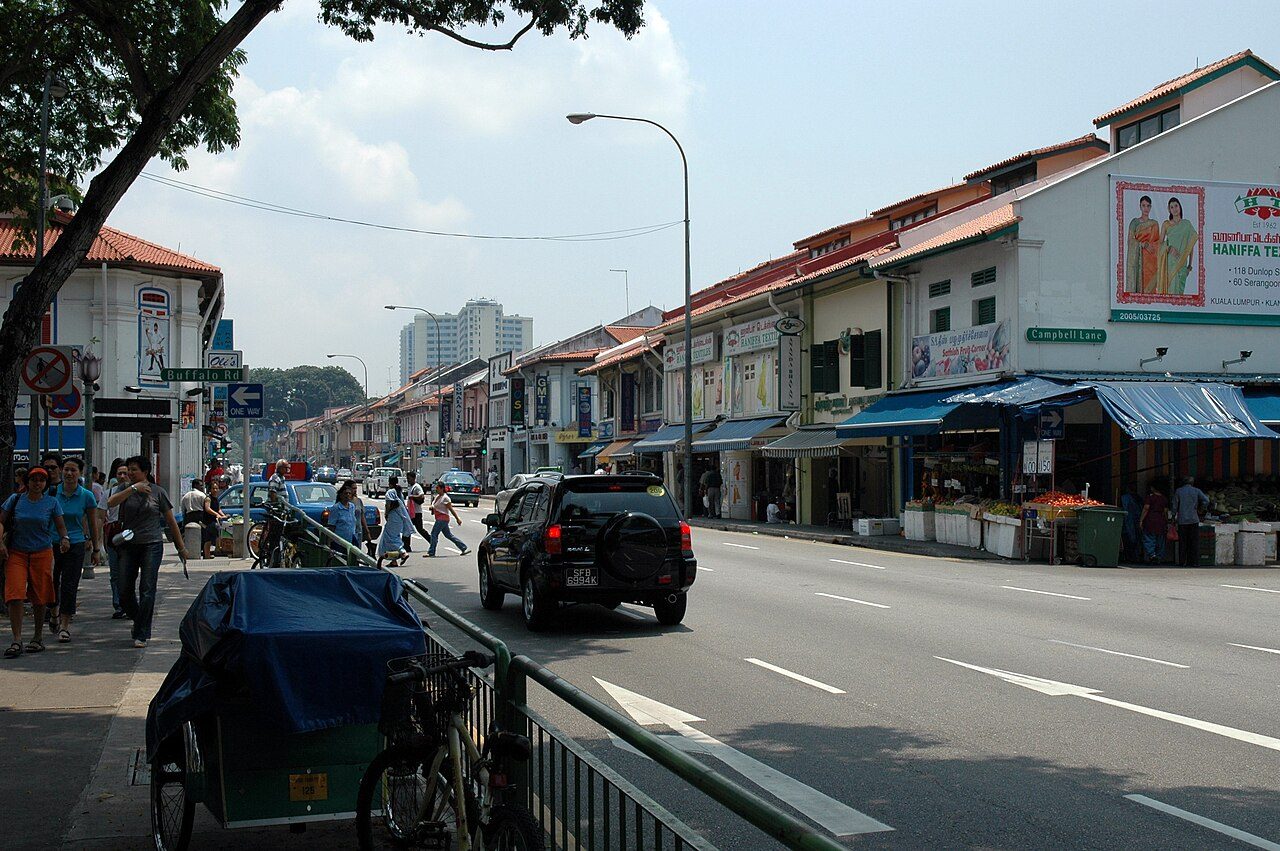
Little India, Singapore
Tracing its roots to the 1840s, when European racecourses, brick kilns, and the cattle-trading enterprise of I.R. Belilios drew Tamil convict laborers and South Indian merchants, Little India remains Singapore’s most kaleidoscopic historic enclave. Anchored along ancient Serangoon Road, the district preserves a kinetic architectural dialogue between South Indian sacred traditions and Straits Chinese vernacular. At its spiritual core stands Sri Veeramakaliamman Temple (established in 1881), whose Dravidian *raja gopuram* (monumental entrance tower) erupts in hundreds of hand-painted, clay-sculpted Hindu deities brandishing tridents and lotus blooms. A few streets away, the restored 1900 villa of Tan Teng Niah presents a striking counterpoint: an eight-room southern Chinese commercial residence painted in exuberant, candy-colored sweeps of pistachio green, saffron yellow, and cerise. Navigating Campbell Lane and Dunlop Street, travelers are enveloped in a layered sensory cadence. The air hangs heavy with the sharp aroma of freshly bruised cardamom, burning camphor, and thick garlands of orange marigolds and night-blooming jasmine woven curbside. Intricate *kolam* rice-powder mandalas mark shop thresholds, while the drone of nadaswaram pipes and chiming brass bells blends with the clatter of stainless-steel thali platters. Between bolt-crammed textile shops displaying radiant Kanchipuram silk saris and the gleaming vitrines of traditional goldsmiths, the neighborhood sustains an authentic, living rhythm that thoroughly resists the sterile glass-and-steel modernity of the surrounding city.
More in Singapore
Photo credits (2)
- Nachoman-au, CC BY-SA 3.0, via Wikimedia Commons
- Terence Ong at the English Wikipedia ., CC BY 2.5, via Wikimedia Commons