
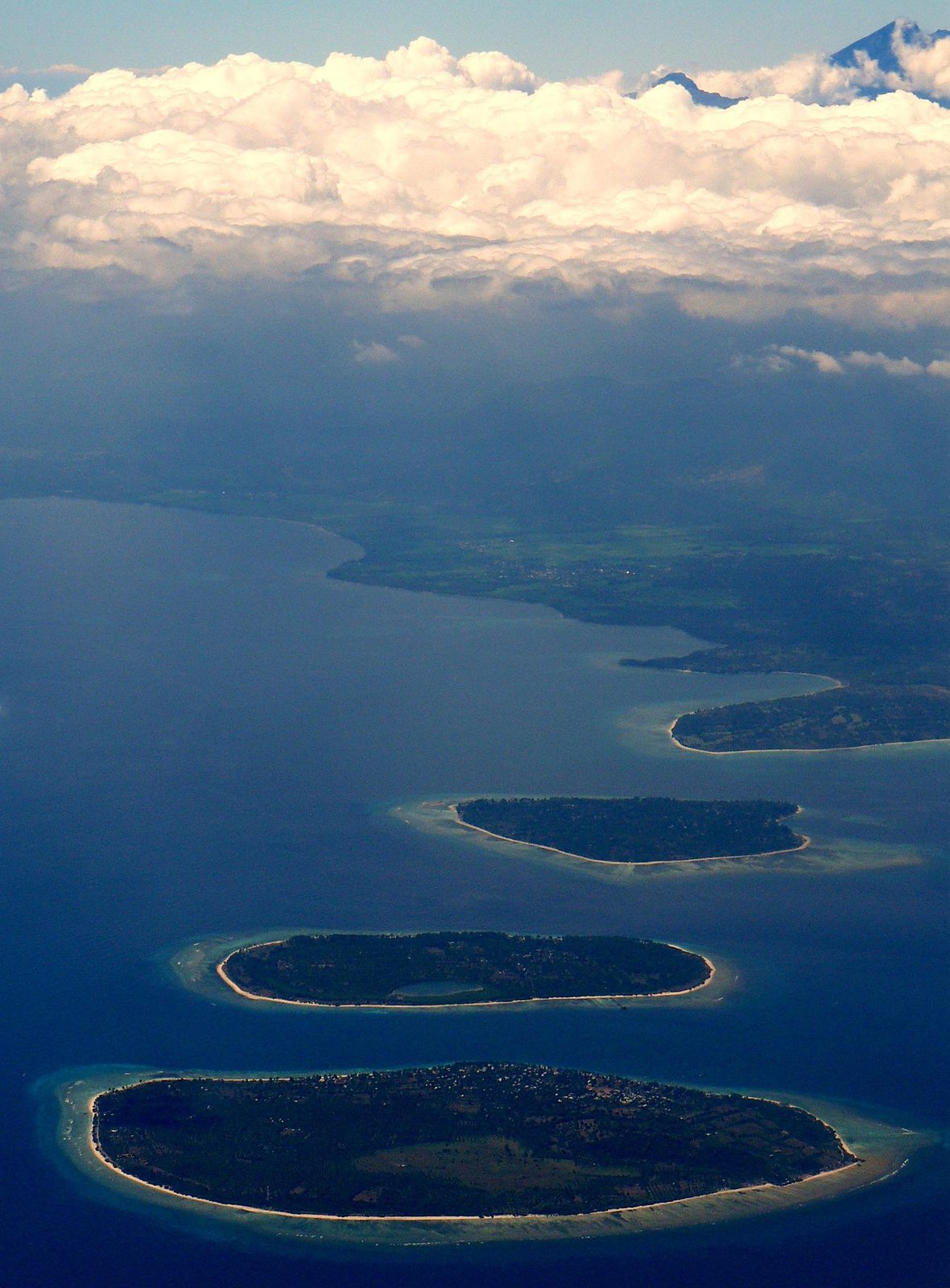
Gili Islands
Rising like low-slung jade medallions from the sapphire depths of the Lombok Strait—accessible just off the coastal highway from Senggigi—the trio of Gili Trawangan, Gili Meno, and Gili Air hold a layered maritime past. Largely uninhabited until Bugis seafarers from Sulawesi established coconut groves and fishing outposts here in the early 20th century, the islands served a far starker purpose during World War II when Imperial Japanese forces converted Gili Trawangan into a fortified lookout. Hikers ascending Trawangan’s modest 70-meter ridge still encounter the weathered concrete remnants of Japanese machine-gun bunkers and subterranean tunnels, relics looming silently over the surrounding fringing reefs. Down along the sand, motorized combustion vehicles are strictly prohibited by local customary law (*awig-awig*), leaving the island’s soundscape to the rhythmic jingle of brass bells on horse-drawn *cidomo* carts and the crunch of bicycle tires on crushed coral paths. Wading directly from the blindingly white shoreline into the warm shallows of Gili Meno, swimmers encounter Jason deCaires Taylor’s submerged sculpture, *Nest*—forty-eight life-sized concrete figures intertwined in a circle, slowly being reclaimed by soft corals and browsing green sea turtles. At twilight, the tide retreats over iridescent flats, and the evening breeze carries the distant call to prayer while the volcanic profile of Bali’s Mount Agung cuts a jagged black silhouette against a violet horizon.
Photo credits (1)
- Kok Leng Yeo from Singapore, Singapore, CC BY 2.0, via Wikimedia Commons