
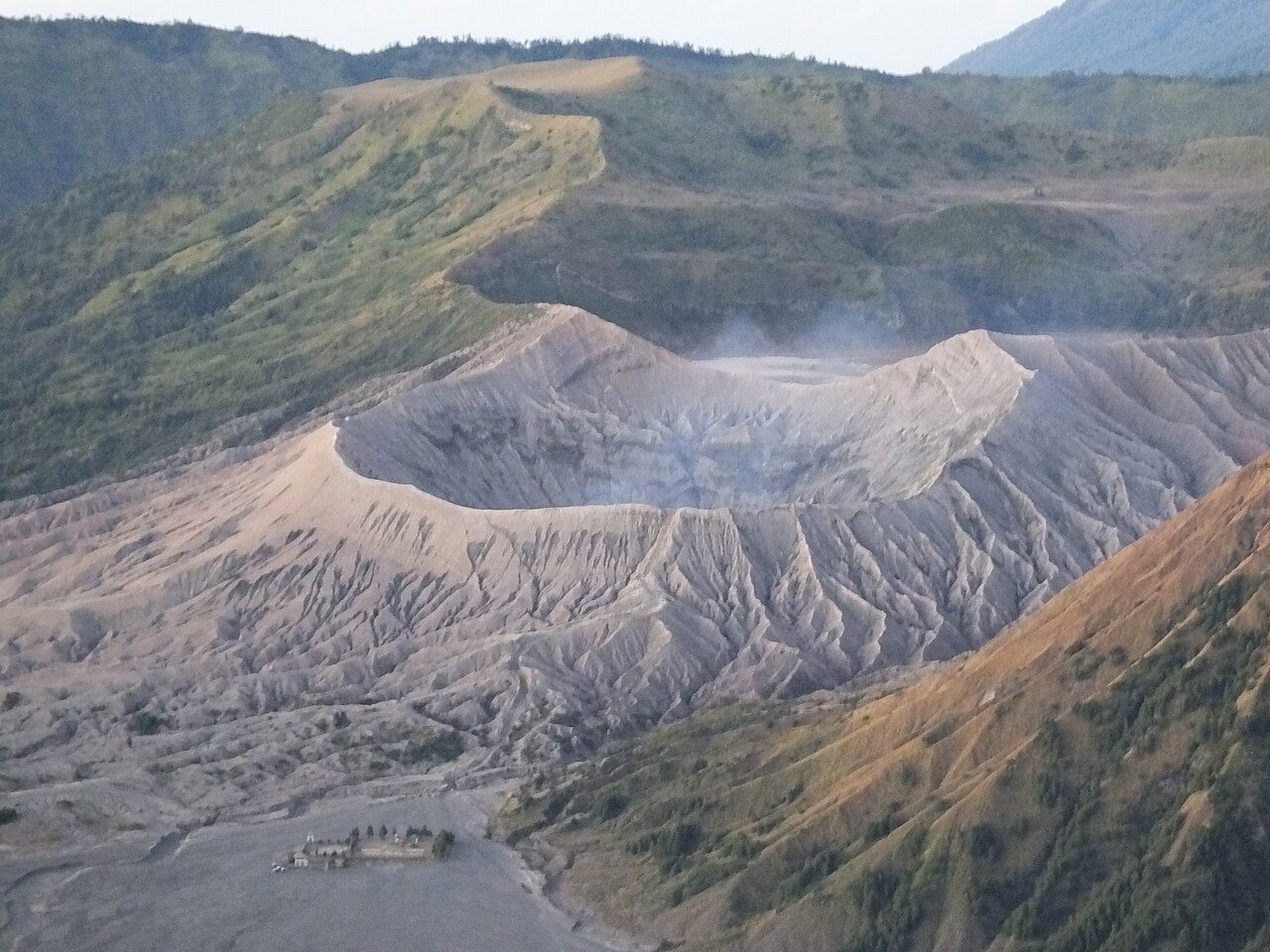
Mount Bromo
When the Hindu Majapahit Empire fractured in the late fifteenth century, devout refugees fled into the jagged highlands of East Java, establishing the Tenggerese civilization around the fiery chasm of Mount Bromo—an earthly manifestation of Brahma, the creator. Rooted in the legend of Princess Roro Anteng and Joko Seger, who sacrificed their twenty-fifth child to quell the mountain’s fury, the crater remains an active altar celebrated during the midnight *Yadnya Kasada* festival. On the desolate, rippled expanse of the *Segara Wedi* (Sea of Sand) below the cone, the isolated temple Pura Luhur Poten rises from the volcanic dust. Constructed from pitch-black igneous stone, its towering *candi bentar* split gateways evoke ancient Javanese sanctuary architecture amidst an austere, extraterrestrial desert. Reaching the caldera's precipice demands navigating a biting pre-dawn alpine chill before scaling a steep staircase of roughly 250 concrete steps encrusted with windblown tephra. At the summit, the narrow rim plunges sheer into an 800-meter-wide roaring abyss, where churning vents violently expel billowing plumes of yellow sulfur steam. Travelers standing along the parapet are engulfed by an intense sensory collision: the sharp, metallic tang of volcanic gas, the vibrating subterranean growl that shakes the soles of one's boots, and the sweeping morning panorama as golden light fractures across the barren caldera floor, silhouetting the fluted ridges of extinct Mount Batok against the distant, brooding titan of Mount Semeru.