
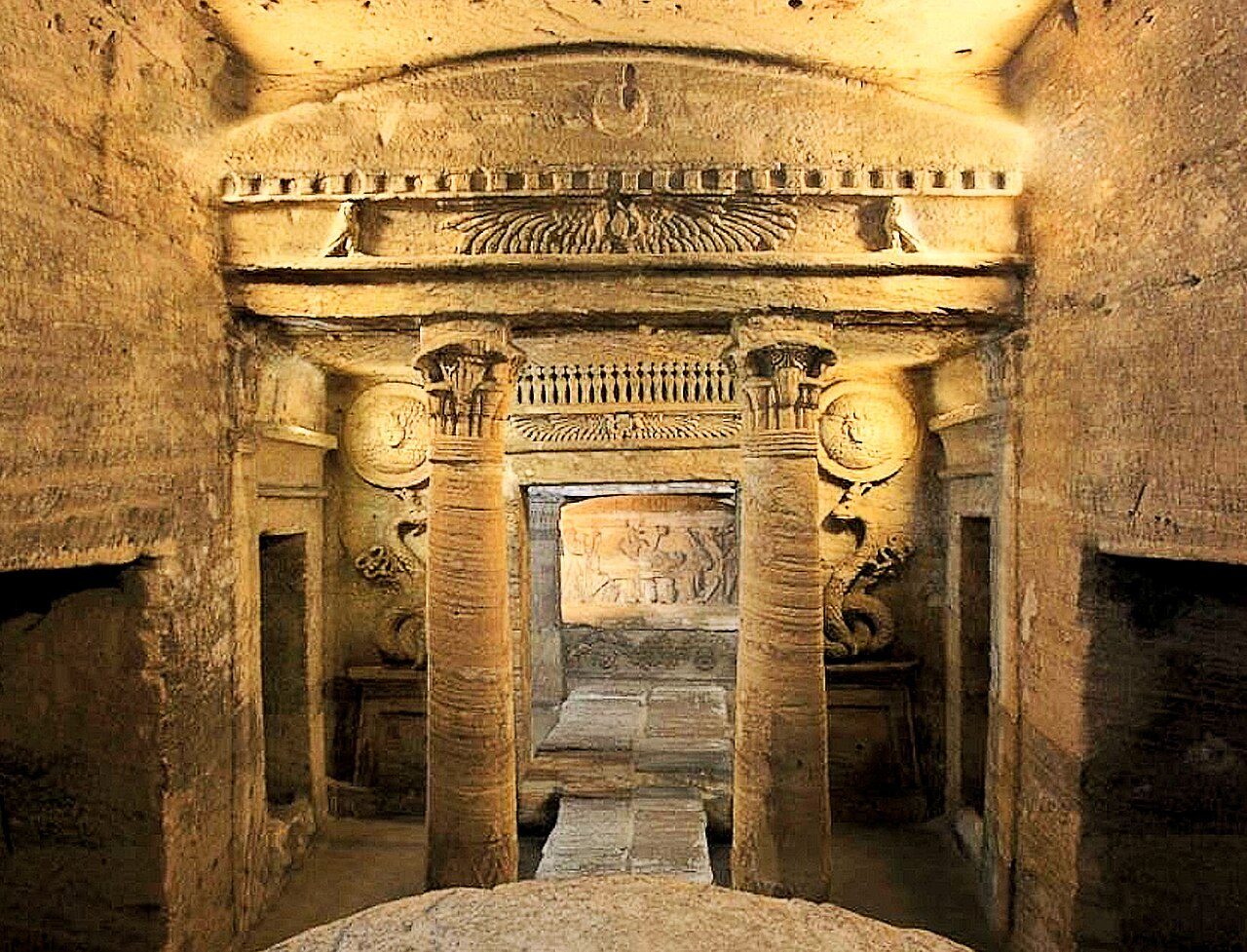
Catacombs of Kom El Shoqafa
Descending a broad spiral staircase carved directly into solid bedrock, travelers leave Alexandria’s sun-bleached streets and enter a subterranean necropolis excavated in the second century AD. Accompanying the descent is an immediate shift in atmosphere—the air turns cool and humid, smelling faintly of ancient, damp limestone. Accompanying the discovery of the site in 1900, when a work donkey reportedly tumbled through the ground, this three-tiered complex descends over thirty meters into the earth. At its heart lies the central rotunda and the *triclinium*, a subterranean banquet hall where grieving relatives once reclined on stone couches to consume farewell feasts beside open shafts that lowered sarcophagi into the deep. In the vestibule of the main burial chamber, the distinct clash of pharaonic tradition and Greco-Roman fashion reaches an astonishing crescendo. Relief carvings show the jackal-headed god Anubis clad in the armor of a Roman legionary, carrying a javelin and shield, while the Agathodaimon serpents flanking the doorway wear the pharaonic double crown while coiling around Dionysian thyrsi. Passing rows of rock-hewn *loculi* that once held hundreds of bodies, visitors confront an eerie, hybrid underworld that illustrates how Alexandria fused imperial Roman authority with eternal Egyptian death rites.
More in Alexandria

Photo credits (2)
- Asiatologist, CC BY-SA 4.0, via Wikimedia Commons
- Rijksmuseum, CC0, via Wikimedia Commons