
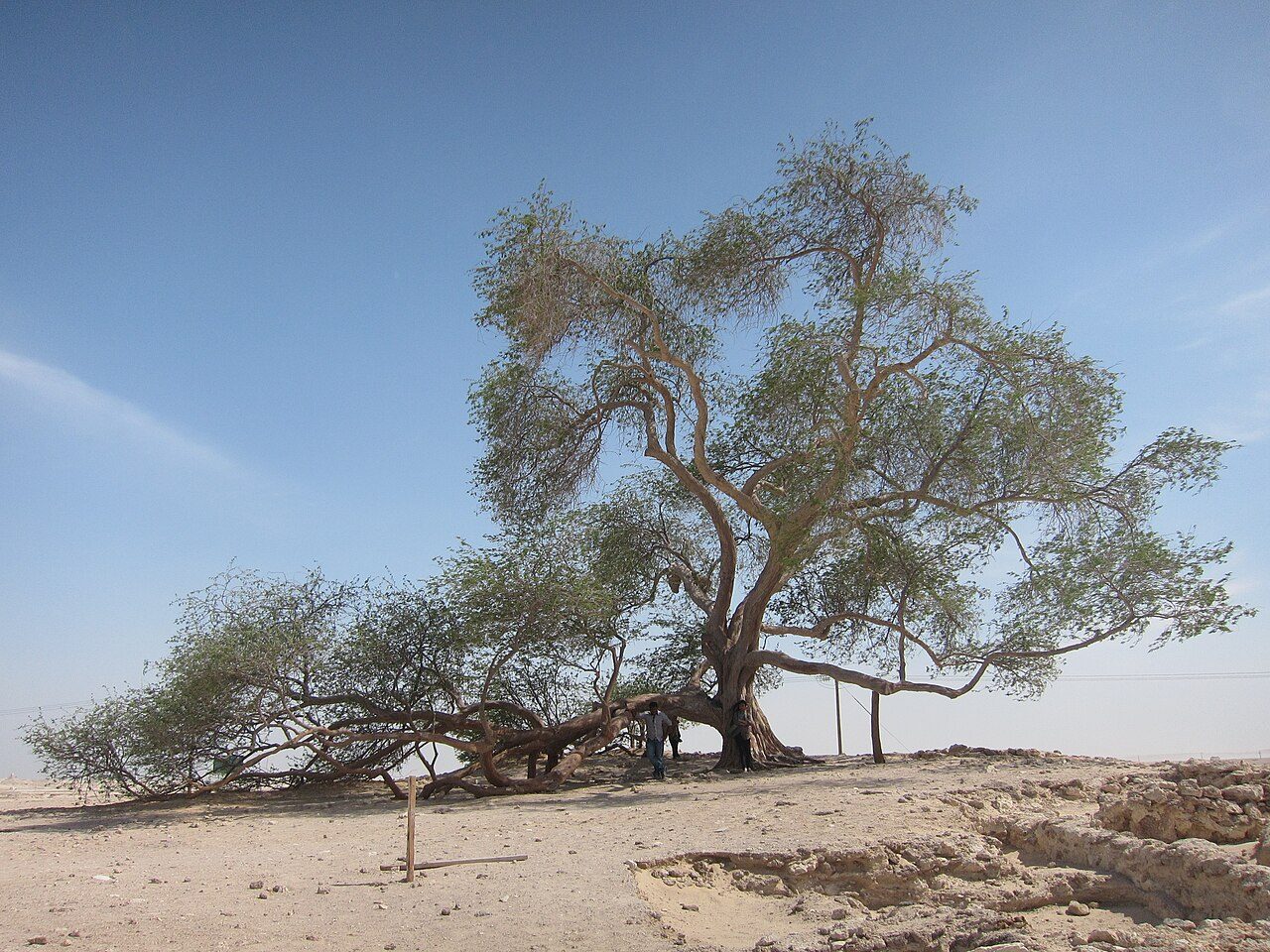
Tree of Life
Rising alone from a windswept limestone mound in the Sakhir desert south of Manama, the *Shajarat-al-Hayah* has defied ecological reality since roughly 1583. Sprouting in the twilight of Portuguese maritime influence across the Persian Gulf, this four-century-old *Prosopis cineraria* (ghaf tree) thrives miles from any visible water source or neighboring vegetation. Bedouin legends historically tied its survival to Enki, the ancient Sumerian deity of freshwater and creation, while regional lore romantically connects the desolate site to the epic, paradisiacal lands of the bronze-age Dilmun civilization. Although botanists suspect an exceptionally deep, fifty-meter taproot system siphoning elusive subterranean aquifers, the exact hydrology sustaining its perennial vitality remains a tantalizing natural puzzle. Approaching the isolated giant, travelers confront a startling collision of stark desert barrens and lush vitality. The specimen stretches nearly ten meters high, its thick, heavily grooved trunk contorting into sprawling, muscular limbs that form a magnificent thirty-meter-wide canopy of feathery emerald foliage. Standing in the sun-baked silence, visitors feel the desert breeze rustling through the leaves, cutting the dry heat with pockets of shaded respite, accented by the sharp, resinous aroma of weathered wood and sun-warmed sap. Ringed by a subtle protective trench set against the pale, sun-bleached gravel and distant silhouettes of desert derricks, this solitary survivor commands the horizon with arresting, sculptural grace.
More in Manama
Photo credits (5)
- കാക്കര, CC BY-SA 3.0, via Wikimedia Commons
- Diego Delso, CC BY-SA 4.0, via Wikimedia Commons
- أبو الشاي حليب, CC BY-SA 4.0, via Wikimedia Commons
- Zairon, CC BY-SA 4.0, via Wikimedia Commons
- B.alotaby, CC BY-SA 4.0, via Wikimedia Commons