
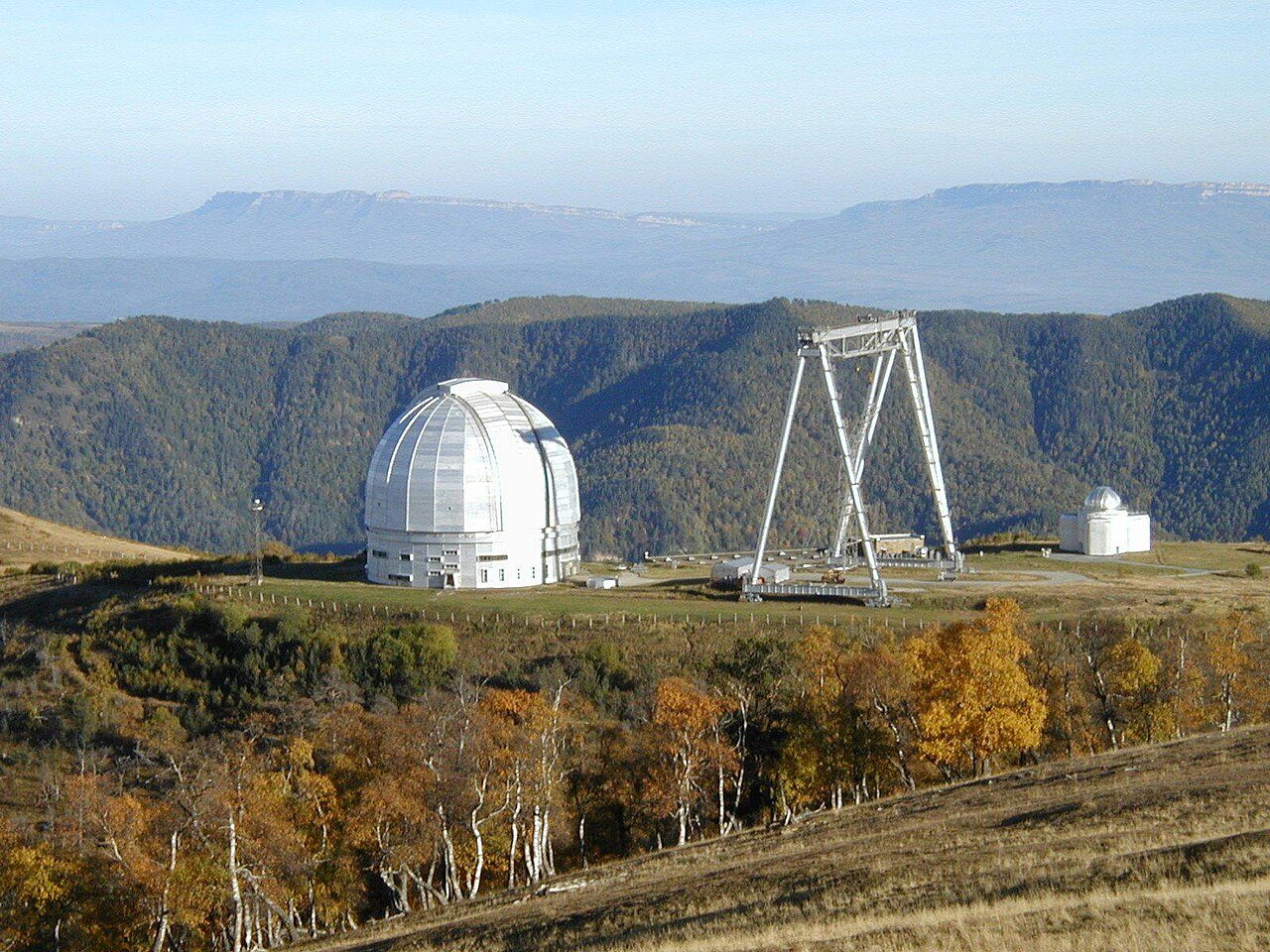
Special Astrophysical Observatory
Perched at an elevation of 2,070 meters on the northern slopes of Mount Pastukhov, this scientific monument arose in 1966 under the auspices of the USSR Academy of Sciences. At its heart sits the BTA-6 (Large Altazimuth Telescope), engineered by chief designer Bagrat Ioannisiani, which held the mantle of the world’s largest optical instrument when it achieved first light in 1975. Architecturally, the site epitomizes late-Soviet functionalism: a colossal 53-meter-tall, aluminum-sheathed dome gleaming chalk-white against the pine-clad ridges of Karachay-Cherkessia, evoking an austere cosmic citadel grounded in the rugged Caucasus wilderness. Stepping through the airlock into the cavernous observing floor, travelers are struck by an immediate bite in the air; the interior is deliberately chilled during the day to match nocturnal mountain temperatures and prevent heat turbulence from blurring exposures. Inside, a towering framework painted deep industrial blue cradles the 42-ton, six-meter-wide primary mirror, a legendary optic cast from solid borosilicate glass. The faint scent of machine oil and ozone hangs in the stillness as the dome’s immense curved shutters part, framing sweeping vistas of alpine peaks and immersing visitors in an active temple of deep-space discovery.