Bezengi Wall
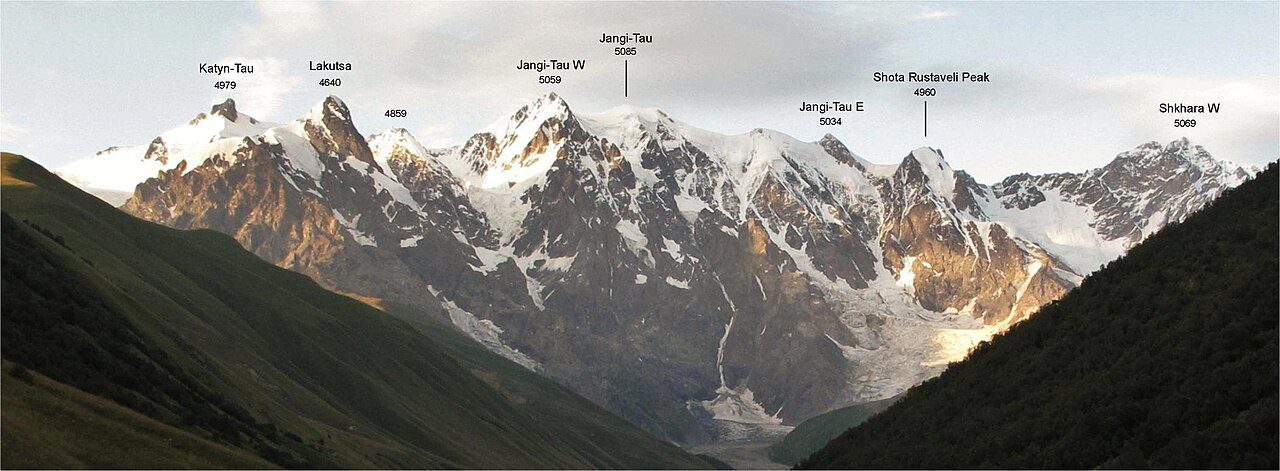
Looming deep within the Kabardino-Balkar High Mountain Reserve south of Nalchik, this twelve-kilometer serrated bulwark of black gneiss and hanging ice forms the most formidable crest of the Greater Caucasus. Often dubbed the "Caucasian Himalayas," the wall links six of the region's eight peaks exceeding 5,000 meters, crowned by the jagged summits of Shkhara (5,193 meters) and Jangi-Tau (5,051 meters). The rampart’s lore was forged during the late nineteenth-century golden age of exploration—ignited by British climber John Garford Cockin’s daring 1888 traverse of Shkhara—before becoming the rigorous training crucible for legendary Soviet alpinists like Vitaly Abalakov throughout the 1930s. Standing on the vast, gravel-strewn tongue of the Ullu-Chiran glacier, travelers enter a colossal, treeless amphitheater dominated by sheer rock faces rising up to two vertical kilometers above the valley floor. The visual spectacle is stark and monumental, characterized by pale blue seracs, fluted snow couloirs, and vertical granite bands that catch fiery dawn light. The experience here is raw and elemental: the thin, sub-zero air stings the lungs, frigid downdrafts sweep down from the northern precipice, and the vast alpine silence is repeatedly punctuated by the echoing, cannon-like roar of avalanches calving off the upper ice fields.